Lightning Protection Zoning Concept
According to this principle, the structure to be protected must be divided into inner
lightning protection zones according to the risk level posed by the LEMP.
This allows to adapt areas with different LEMP risk levels to the immunity level of the
electronic system.
With this flexible concept, suitable LPZs can be defined according to the number,
type and sensitivity of the electronic devices/systems ranging from small local
zones like enclosures to large integral zones which can encompass the whole building.
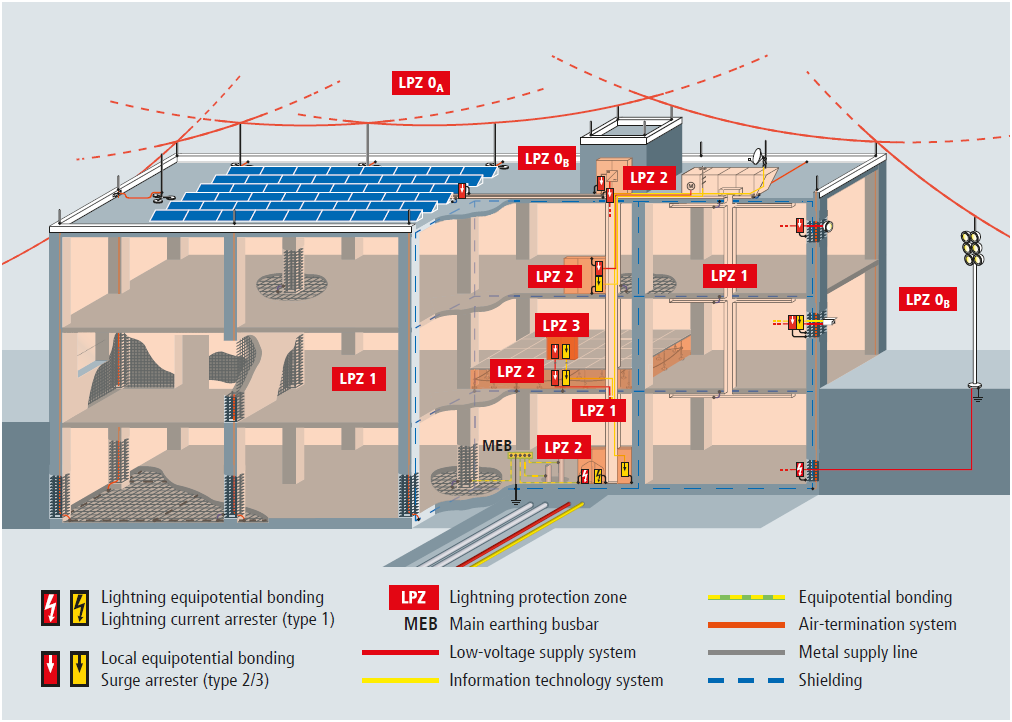
Depending on the lightning threat, inner and outer lightning protection zones are defined
in the SANS 62305-4.
Outer Zones:
-
LPZ 0A - Zone where the threat is due to the un-attenuated
lightning electromagnetic field and where the internal systems may be
subjected to the full or partial lightning current.
The threat is due to direct lightning strikes and the full lightning electromagnetic field. The internal systems may be subjected to the full lightning current (10/350 µs). -
LPZ 0B - Zone where the threat is due to the un-attenuated
lightning electromagnetic field and where the internal systems may be
subjected to the full or partial lightning current.
Zone protected against direct lightning strikes but where the threat is due to the full lightning electromagnetic field. The internal systems may be subjected to partial lightning currents (8/20 µs).
Inner Zones:
- LPZ 1 - Zone where the impulse currents (8/20 µs) are limited by current distribution and isolating interfaces and/or by SPDs at the zone boundaries. Spatial shielding may attenuate the lightning electromagnetic field.
- LPZ 2n - Zone where the impulse currents (8/20 µs) are limited by current distribution and isolating interfaces and/or by additional SPDs at the zone boundaries. Additional spatial shielding may be used to further attenuate the lightning electromagnetic field.